
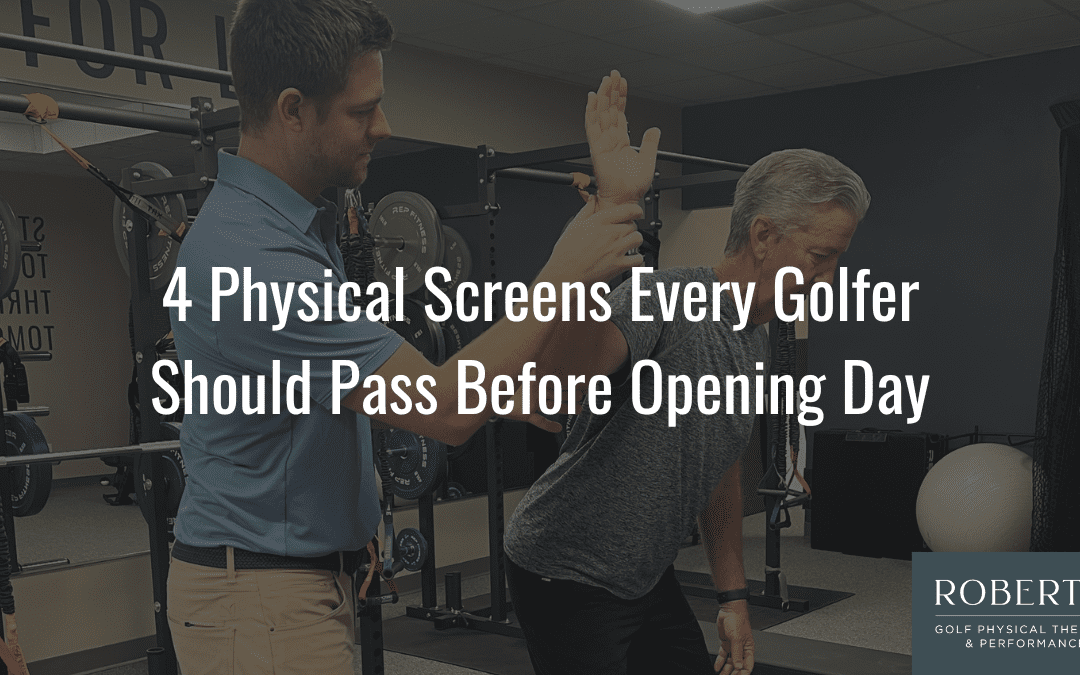
Four Physical Screens Every Golfer Should Pass Before Opening Day
If you live in the Kansas City area, you know the feeling.
The weather starts warming up. Opening day is approaching.
And golfers everywhere start preparing to get back on the course.
Some players hit the range. Some start stretching more.
Some even try to work out a little before the season begins.
But despite good intentions, we see the same pattern every spring.
Golfers feel tight. Their swing feels restricted.
Or their back starts bothering them within the first few rounds.
The issue is rarely effort.
Most golfers are simply missing an important step before the season begins.
They have never checked whether their body is actually capable of making the movements the golf swing requires.
Before a golfer starts increasing practice or playing volume, there are four key areas of movement that should be screened.
These areas drive rotation, power, and consistency in the swing.
1. Neck Rotation
Your neck plays a surprisingly important role in the golf swing.
As you rotate through your backswing and follow-through, your head and eyes must stay oriented toward the ball. That requires adequate rotation through the cervical spine.
If neck mobility is limited, golfers often compensate by restricting their shoulder turn or altering posture during the swing.
Over time this can lead to stiffness through the upper back and increased tension throughout the swing.
2. Thoracic Spine Rotation
The thoracic spine is the engine of rotational movement in golf.
This is the area of the upper back that allows your shoulders to rotate while maintaining posture.
When thoracic rotation is limited, golfers often compensate by rotating excessively through the lower back.
This is one of the most common contributors to early-season back pain.
Improving thoracic mobility often allows golfers to create a smoother and more efficient shoulder turn.
3. Shoulder Mobility
Your shoulders must move freely in multiple directions during the swing.
Restrictions here can shorten the backswing, reduce club speed, and create compensations throughout the body.
When shoulder mobility is limited, golfers often raise their arms excessively or lose connection during the swing.
Addressing shoulder movement can immediately improve swing mechanics and comfort.
4. Hip Rotation
The hips are the foundation of power and stability in golf.
Your lead hip must rotate and accept force as you move through impact.
If hip rotation is limited, golfers often slide laterally, lose balance, or place additional stress on the lower back.
This is one of the most important physical qualities for both performance and injury prevention.
Why This Matters Before the Season Begins
When golfers return to the course after a long winter, they often go from minimal activity to full swings within a short period of time.
If the body does not move well through these key areas, the swing will compensate somewhere else.
Many golfers are surprised when they test these movements for the first time. In fact, most golfers fail at least one of these four screens without realizing it.
That compensation may show up as:
Reduced rotation. Loss of distance. Inconsistent contact.
Or early-season aches and pains
The good news is that most of these limitations can be improved when they are identified early.
That is why we screen golfers for these movement patterns before building a training program.
Want to Test Yourself?
If you want to see how your body stacks up heading into the season, I created a short video guide showing the four physical screens we use with golfers in the clinic.
Each test takes less than a minute and can quickly reveal whether mobility limitations may be affecting your swing.
Submit the form below to download your video guide and assess your swing.
Ready to fast-track your progress?
Schedule an intro call and we’ll identify which rotary center is actually holding you back.