
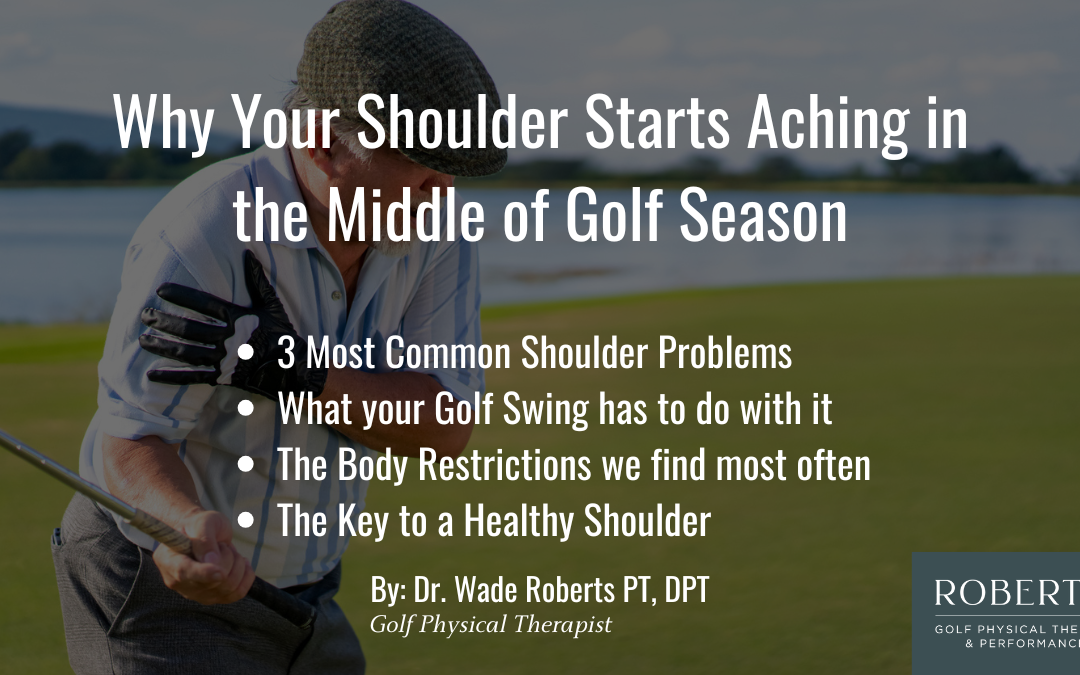
Why Your Shoulder Starts Aching in the Middle of Golf Season
By Dr. Wade Roberts, PT, DPT
RobertsPT
By the middle of golf season, we start seeing a predictable trend.
Golfers who made it through the spring feeling great suddenly begin noticing soreness in the lead shoulder, pain reaching into the back seat, discomfort after a bucket of balls, or aching that lingers well after the round is over.
The good news?
Most of these golfers don’t actually have a “bad shoulder.”
They have a shoulder that’s working far harder than it was designed to.
The Three Most Common Shoulder Problems We See
At RobertsPT, the majority of golf-related shoulder injuries fall into three categories:
- Rotator cuff tendinitis
- Biceps tendinitis
- Shoulder impingement
While these diagnoses sound different, they often have the same underlying cause.
The shoulder is compensating for limitations somewhere else in the body.
What Your Golf Swing Has To Do With It
One swing characteristic we frequently see in golfers with shoulder pain is a steep swing plane, often described as being “over the top.”
When the club travels above the ideal slot during the downswing, the upper body becomes much more dominant. The shoulders and arms are forced to generate power instead of simply transferring it from the ground through the body.
The result?
More stress on the shoulder joint.
More stress on the rotator cuff.
More stress on the biceps tendon.
Many golfers with this pattern also complain about fat divots, inconsistent contact, and casting the club through impact.
While swing mechanics certainly play a role, we often find that the swing is reacting to physical limitations rather than causing them.
The Body Restrictions We Find Most Often
During our golf evaluations, the same movement limitations appear over and over:
- Limited thoracic spine extension
- Limited thoracic rotation
- Reduced hip internal and external rotation
- Limited shoulder external rotation
If your upper back doesn’t rotate well, your shoulders have to create that rotation.
If your hips don’t rotate well, your shoulders have to create that rotation.
Eventually, something begins to complain.
The Thoracic Spine: The Forgotten Key to a Healthy Shoulder
One of the biggest secrets to reducing shoulder pain in golfers isn’t another rotator cuff exercise.
It’s restoring normal movement in the thoracic spine.
Your upper back is designed to extend and rotate throughout the golf swing. When it becomes stiff, the shoulder loses its foundation and is forced to absorb loads it wasn’t meant to handle.
Research from Dr. Jobe and Dr. Pink also demonstrated that the subscapularis, one of the four rotator cuff muscles, is highly active throughout the golf swing. If the rest of the body isn’t moving efficiently, this muscle can become overloaded over the course of an entire season.
Don’t Just Treat the Shoulder
If your shoulder is starting to ache after playing, don’t assume you simply need to strengthen your rotator cuff.
The real question is:
Why is your shoulder doing so much of the work?
That’s exactly what we help golfers answer every day.
We’ll identify the movement restrictions contributing to your pain, improve the mobility that’s limiting your swing, and help you get back to enjoying the game without constantly thinking about your shoulder.
Because the goal isn’t just to get through this season.
It’s to stay in the game for life.
Wondering if your shoulder is moving the way it should?
Schedule a Golf Mobility Assessment with RobertsPT and let one of our Doctors of Physical Therapy evaluate your shoulder, thoracic spine, hips, and golf-specific movement patterns.
Less shoulder pain.
Better contact.
More fairways and greens.
FREE MOBILITY SESSION
Ready to take a look at what may be holding you back?
Schedule your free 20-minute mobility session below!
Ready to fast-track your progress?
Schedule an intro call and we’ll identify which rotary center is actually holding you back.