
If You Can’t Touch Your Toes, Your Golf Setup Is Broken
Before you think about your swing, your speed, or your mechanics…
There’s a good chance your setup is already limiting what you’re capable of.
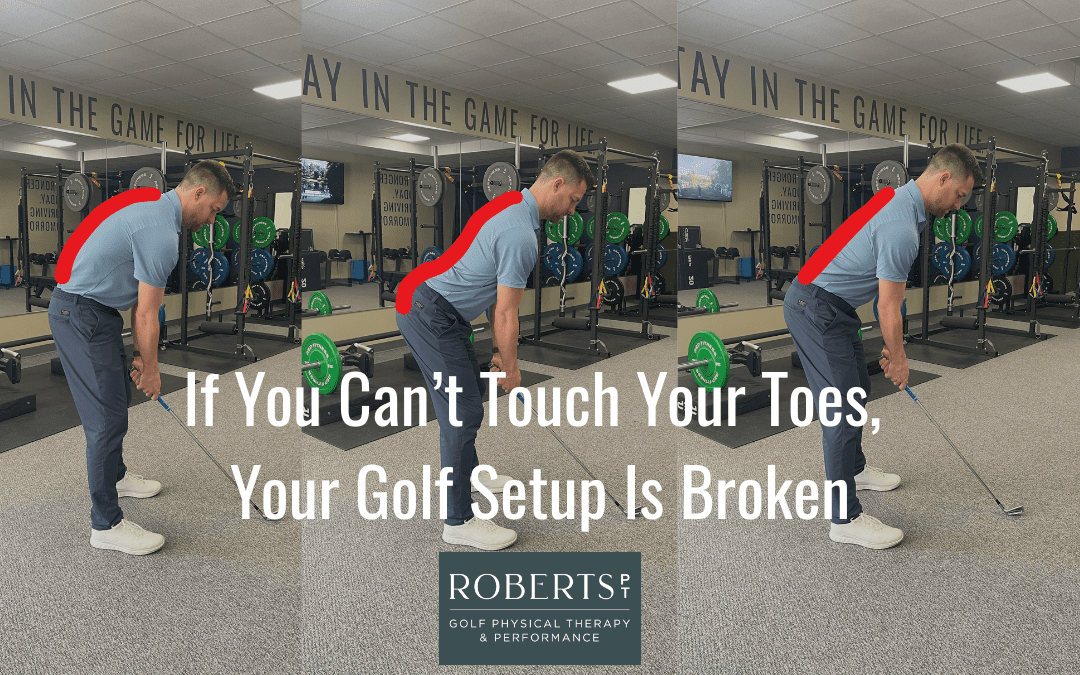
Because for many golfers, problems with how their body feels during a round of golf or how well they are able to turn through the ball begins with the position of their spine at address.
The Mistake: Bending From the Spine Instead of the Hips
When you set up to the ball at address, you should ‘get down to the ball’ by hinging through your hip joints.
Not rounding through your upper back (we’ll call this C-Posture)
Not over-arching through the lower back (we’ll call that S-Posture)
But that’s exactly what many golfers do.
Why?
Because they can’t hinge properly.
Why can’t they hinge?
Either because they physically can’t, or through a misconception on what ‘sticking their butt out at address’ is supposed to be like.
Over time, that leads to two common problems for a golfer:
- C-posture (significantly limits the upper backs ability to rotate )
- S-posture (excessive stress in the low back leads to stiffness and even worse, actual pain)
Let’s look more closely at S-Posture.
Why S-Posture Matters
S-posture is one of the leading contributors to low back stiffness in golfers.
When you over-arch your lower back at setup:
- You create excessive tension in the lumbar spine
- You actually shut down the ability of the hip joint to rotate (which is why the back also takes a beating)
- You set your body up for a similar positions of low back stress at the top of the swing and at impact by starting this way.
Now multiply that across 50–80 swings in a round…
And it’s no surprise your back tightens up or starts barking at you.
It depends on your answer to this question: Can You Touch Your Toes?
This is where it gets simple and one of our key mobility tests for our golfers.
If you can’t touch your toes, it’s very hard to consistently get into a proper golf posture.
Why?
Because a good toe touch requires:
- Uniformity in your spine flexing
- Good posterior chain length
- An appropriate weight shift posteriorly as you go down
If you don’t have those, your body will compensate into the ‘C’ and ‘S-Posture’ positions at address.
What a Good Setup Should Feel Like
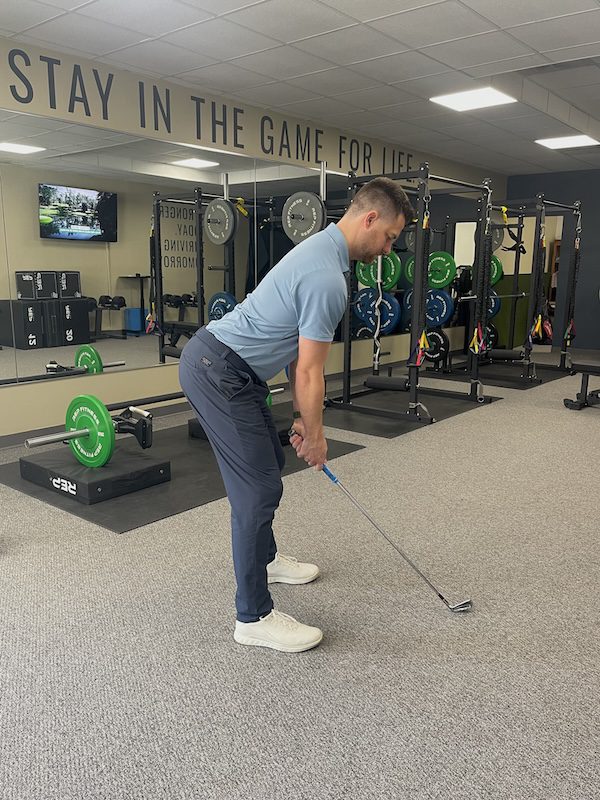
A proper golf posture should feel:
- Like you’re pushing your hips back behind you
- Slight bend in the knees
- Neutral spine (not rounded, not over-arched)
- Weight balanced through the middle of your feet
If you filmed yourself from the side, your upper and low back should look flat and stable… not curved excessively in either direction.
What To Do Next
Take 30 seconds and test this:
Try to touch your toes!
Can you hinge forward and touch your toes without bending your knees excessively?
If not, your body is already telling you something.
And if you ignore it, your set up will be physically unable to get into the necessary position.
The Better Approach
The goal isn’t just to “stand better” over the ball.
It’s to build the mobility and control that allows you to get into that position naturally.
I’ve heard it all the time, “Wade – I haven’t touched my toes in 30 years there’s no way I’ll be able to do that!”
But we’ve seen over 600 golfers now be able to touch their toes who originally weren’t or were doing it with the wrong pattern.
That’s where the right combination of:
- Mobility work
- Strength training
- Movement patterning
…makes all the difference.
Because when your setup improves, everything downstream becomes easier:
- Cleaner rotation to the top
- Better contact at impact
- Less stress on your body
And most importantly… you are extending years to golf life without pain.
Hit em’ straight,
Wade
P.S. If you want a few of my favorite ways to improve your toe touch, I’ll send ya a video or two to try, totally free, just email me at wade@robertspt.golf, you’ll feel the immediate difference right there at home.
P.S.S. If you’d rather skip the guesswork, we’ll walk you through this in person during a free mobility session. It takes about 20 minutes and you’ll know exactly what’s limiting your setup and what to do next. Click here to see if you qualify and grab a time.
Ready to fast-track your progress?
Schedule an intro call and we’ll identify which rotary center is actually holding you back.